Free template
Free business growth plan template for Word
This growth plan template is a free Microsoft Word document for owners and managers who need an expansion approved, say a second branch or a new product line.
- Rationale and hypothesis
Background and research, then one if-then sentence you can be held to.
- Primary and secondary targets
One result that matters most. The rest follows from it.
- Timeline and team tables
Due date, task, owner and notes for each step.
- Before-and-after results
A filled example to copy: 2 to 4 locations, 60 to 170 staff.
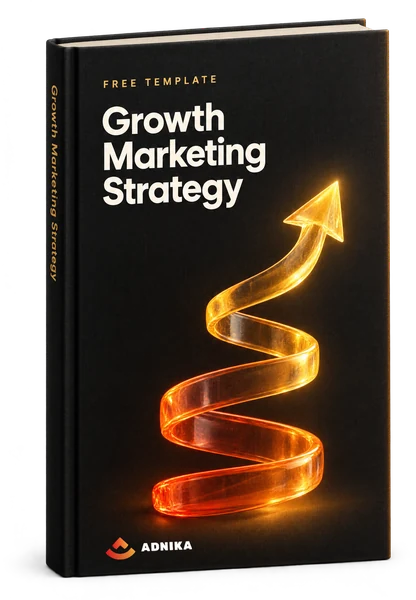
Get the growth plan template
Your template is ready
Download the ZIP and open the Word file inside. Start with the Research section, because the targets depend on it.
Download Growth Strategy TemplateA copy is on its way to your inbox too.
What's inside
What's inside the growth plan template
One Word document, about 800 words, 7 sections, each answering a question approvers ask.
Executive summary
You open with a title page, then 1 to 2 pages on the type of expansion, why, the expansion goals, the timeline, the funds and the expected ROI (return on investment). For some readers that's the entire plan.
Growth rationale
This is where you argue the case: background, research (market research, customer surveys, financials, industry trend reports) and an if-then hypothesis. The file's example is a new division bringing 40% more revenue, 15% more profit and 40 new employees.
Growth targets
Pick from 8 growth types (headcount, space, branches, regions, products, outlets, revenue, customers), then set primary and secondary targets. Choosing the primary one is harder than it looks; everything hangs on it.
Growth action plan
Two tables. The timeline asks for due date, task, task owner and notes; the team table wants name, team, role in project and email. Between them they settle who does what by when (and who to chase).
Growth requirements
What it will take: funding (how much capital the business needs, and from where), tools and software, outside services such as consultants, and other resources needed. Can you afford the plan? This section tells you.
Results table and appendix
A before-and-after table defines success in numbers (original, target, net and % increase). You get it twice, filled in as an example and blank. The appendix is for proof: vendor quotes, renderings, forecast spreadsheets, market research.
How to fill it in
How to write a business growth plan
Don't fill it in top to bottom: evidence first, summary last, once there's a plan to summarise.
Start with research and the hypothesis
Fill in Background and Research first. Research has to bridge the gap between idea and hypothesis, so gather your market research, customer surveys and financials, and get input from finance. Then write one if-then sentence with numbers. Can't yet? Then you're not ready for targets.
- Numbers, not adjectives
- A source for every claim
Set one primary target and its knock-ons
Make the growth type that matters most your primary target, with today's number beside it. Then add the secondary targets that follow, like how many employees new demand needs. Write each as a SMART goal: specific, measurable, achievable, relevant and time-bound.
- One primary target, not five
- Record today's number
Turn targets into tasks, costs and a summary
Break down goals into actionable steps in the timeline table, each with a due date and one named owner. That table is your roadmap. Cost everything (funding, tools, outside help) and set a monthly milestone so you can track your progress. Write the executive summary last.
- One owner per task, not a department
- Attach the quotes behind the funding
Guide
A growth plan example and the mistakes to avoid
Plans stall on the numbers, not the format.
Business growth plan example
Say you run 2 physiotherapy clinics with 16 staff and $1.8 million in yearly revenue (an invented example), and you want a third. Hypothesis: if clinic 3 reaches 70% of an average clinic's revenue in its first full year, then revenue rises to $2.43 million, your primary target. The secondary target, 8 hires, tends to slip (clinicians take months to recruit). In this example's results table: 2 to 3 locations (+50%), 16 to 24 staff (+50%), revenue up 35%.
Mistakes that get plans sent back
The classic mistake is a target with no starting number. 'Grow the customer base' can't fail, and that's the problem; '400 to 950 customers' can. Close behind: a hypothesis that's really a wish, tasks owned by 'marketing' rather than a person, funding with no source, and four primary targets. One primary target helps everyone stay focused when money gets tight.
Adapting the growth strategy template
Small teams can cut it to 2 pages: one target, a short timeline, a funding line and the results table. Larger companies need one plan per initiative, signed off by finance. B2B plans need room for long sales cycles, since new business won in month 3 may not bill until month 6. In B2C, plan for the seasons; a Gulf retailer, for example, staffs up for Ramadan and Eid.
Read moreWhat good looks like
A good plan reads like a set of bets with the evidence attached. Each target has a baseline, a date and a KPI (key performance indicator); each task has an owner. Revenue targets need the firmest evidence: HubSpot's 2025 State of Sales report found 59.9% of sales teams on track to meet or beat theirs, so a big share aren't. Budgets get questioned too: in HubSpot's 2026 State of Marketing report, 73% of marketers said their budget gets more scrutiny now than in the past.
Where marketing fits in
If the primary target is customers or revenue, marketing belongs inside the plan. HubSpot's 2026 State of Marketing report found 56% of marketers say it's easier to grow lead numbers than it was a decade ago. Leads aren't customers, though. Put the follow-up in the timeline: who calls them, how quickly, and what share you expect to buy. That's where growth strategies often stall.
Read moreWork with us
How we can help you grow
Adnika is a design, build and grow agency. These are the parts of the plan we can take on.
- 01
Growth marketing
We find where buyers drop out, then test fixes and report against your plan's targets.
- 02
Entering a new market
New region or product? We'll plan the launch: who to target first and what to say.
- 03
CRM set-up
We set up your CRM (customer relationship management) system so the results table runs on real records.
FAQ
Growth plan template FAQ
In short: one primary target, and numbers you can check.
Market penetration, market development, product development and diversification. They're the four boxes of the Ansoff matrix, which crosses current or new products with current or new markets. Diversification carries the most risk. Your primary target usually shows which one you're pursuing.
Enough to answer five questions: why grow, what, how, with what and what changes. This one does it in 7 sections: executive summary, rationale, targets, action plan, requirements, results, and an appendix for your evidence.
The template's filled example takes a business from 2 to 4 locations, 60 to 170 employees, 400 to 950 customers and $8 million to $21 million in revenue. Ambitious, but each target sits beside its starting number, so you can measure progress.
Scope. A business plan covers the whole company and how it makes money. A business growth plan covers one expansion, like a new branch, with its own targets and budget. Start with a business plan template; use this one to grow your business.
Not really. If you're planning your own career, it isn't the right template. Personal and professional development plans deal with career growth, leadership skills and self-assessment, while this one is built for a company's expansion. The structure carries over; most prompts don't.
Check the timeline monthly and re-forecast the targets each quarter. Monthly checks show what's working and catch late tasks early; the quarterly review is where you adjust the plan if the hypothesis isn't holding. A new primary target means a new plan.
No questions match — try another search.
More free templates
More free business templates
Expansions rarely stop at one document. These pick up where this one ends.
 Kit
A/B Testing Kit
A significance calculator and a test tracker in Excel, for deciding when an A/B test result is real and keeping a record of every test you run.Get the free kit Template
Productivity Templates
An Excel workbook with a task prioritisation score, a team hours calculator and progress charts for keeping a project on track.Get the free template Template
Marketing Plan Template
A Word marketing plan template with a SWOT table, target market and personas, a marketing mix section, a budget table and a channel plan.Get the free template Template
Social Media Content Calendar
An Excel calendar for planning posts on X (Twitter), Facebook, LinkedIn, Instagram and Pinterest, with a monthly planner, a posting schedule and a content library.Get the free template
Free download
Start planning your growth with the free template
The Growth Strategy Template is a free Word file: 7 sections, 4 tables. Fill in the form and the link appears here.