Free kit
Go-to-market strategy template kit: 14 free product marketing files
This go-to-market strategy template kit gives founders, product marketers and sales leads 14 editable files covering positioning, personas, pricing, sales, release planning and a product deck. The guide below says where to start.
- Positioning grid and SWOT
Place yourself against rivals, then test that spot honestly.
- Segments and product type
19 fields per segment, plus how people shop for what you sell.
- Pricing calculator
Per-unit costs in; prices at 5 margin levels and profit at 4 volumes out.
- Launch tracker and sales plan
Owners, deadlines, legal sign-off and translation status for every asset.
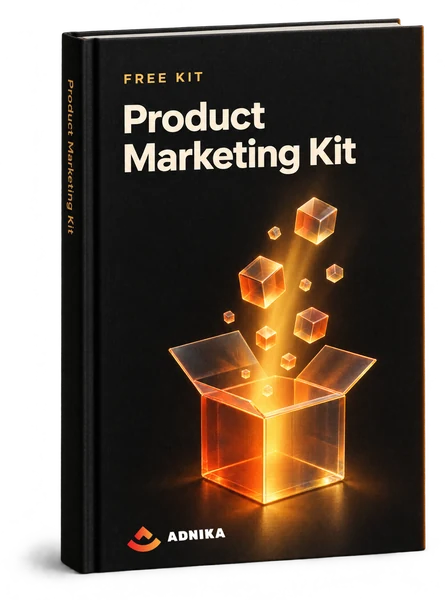
Get the free kit
Your kit is ready
Save the ZIP with the download button. Open the buyer persona workbook and the positioning grid first; the other 12 files build on them.
Download Product Marketing KitA copy is on its way to your inbox too.
What's inside
Inside the go-to-market strategy template kit
The ZIP holds 14 templates: 9 Excel workbooks, 4 Word documents and 1 PowerPoint deck. Here is what each contains and the decision it informs.
Where the files come from: the 14 templates are HubSpot's Product Marketing Kit, file for file. Our part is this page: which file to fill in first, and an example of how they fit together.
Buyer persona and product classification
The buyer persona workbook gives each segment 19 fields in 5 groups, with a filled example. The classification sheet sorts your product as convenience, shopping, speciality or unsought. Together they settle your target audience and how much convincing it needs.
Positioning grid and SWOT analysis
A 2x2 grid plots complexity against uniqueness, with 4 quadrants: niche, premium, volume and value. Place yourself and each rival on it, then use the SWOT workbook to weigh that market position against your strengths, threats and market opportunities. Picking a quadrant is easy; defending it isn't.
Product pricing calculator
Four small sheets collect material, labour, overhead and other costs per unit, with a filled example. The main sheet totals them, prices the product at 5 margin levels and shows profit at 500 to 2,000 units. That's the floor under your pricing strategy.
Goal setting template
SMART tables for 3 primary and 3 secondary goals, a breakdown of KPIs (key performance indicators), budget and resources, a DRI (the one directly responsible person) per goal and a 5-milestone tracker. This template helps tie product goals to business goals before money is spent.
Sales plan and product deck
The Word sales plan covers team, target market (including who you won't sell to), tools, competitor counterpoints, prospecting criteria, quarterly targets and budget. The 20-slide deck carries the same product messaging to buyers: pain points, features, market size, pricing plans and a call to action.
Content planning workbook
Five content marketing tabs: what each buyer needs at the awareness, consideration and decision stages, ideas scored on benefit against cost, a 5-week campaign plan, a monthly calendar and a tracker for traffic, leads and revenue. It shows which content to make first.
Launch planning workbook and update email
Three tabs: each asset's owner, due date, translation status and legal sign-off; team readiness and roadblocks; and a social and PR posting plan. The Word email template ensures stakeholders get a weekly status note with a countdown, so progress stays easy to track.
Roadmap, development plan and life cycle map
A 12-month timeline with 7 colour-coded workstreams, including market research and sales enablement; a Word product development plan in 9 sections; and a sheet tagging each product's life cycle stage. Together they time the release to what's ready.
How to use it
How to create a go-to-market plan with these templates
Used in this order, the 14 files work as one go-to-market plan template. Jump straight to the deck and you'll rewrite it twice.
Pick the segment you'll win first
Start with the buyer workbook: knowing your audience shapes every other file. Write one row per segment of potential customers, then cut to the 1 or 2 you can reach this year (market segmentation is choosing, not listing). Then classify the product, since shopping products need comparison content and convenience products need reach.
- One row per segment, then cut
- Classify the product type
Choose a position, then a price
Plot yourself and your 3 closest rivals on the grid, run the SWOT on your quadrant and write the core message in one sentence. Only then open the pricing calculator. Cost-plus gives you a floor, not a price based on market value; if that floor sits above what rivals charge, it's a positioning problem, and cheaper to find now.
- 3 rivals on the grid
- Floor price from the calculator
Decide how it gets sold
Choose the motion first (product-led, sales-led or partner-led), then write the sales plan's prospecting and action plan sections to match. Map content to each buying stage so both teams align on who they're chasing. Check the budget follows the motion: a free trial and a field sales force cost very different amounts.
- Prospecting criteria first
- Content by buying stage
Set goals, owners and dates
Turn the plan into SMART goals with one owner each, then load every asset into the planning workbook with a due date. Flag anything that needs legal review or translation. In the final weeks, send the update email every Monday; it's the cheapest way to spot a slipping task before go-live exposes it.
- SMART goals, one owner each
- Every asset logged
Guide
Go-to-market strategies, examples and KPIs
The kit gives you the parts. These are the judgement calls in between, starting with how a go-to-market (GTM) strategy differs from your other marketing strategies.
Go-to-market strategy vs marketing plan vs launch plan
A go-to-market strategy decides who you'll sell a new product or service to, why they'll pick it, what it costs and how it reaches them. Marketing's yearly plan covers your marketing efforts across products. A sales plan sets sales strategies and quarterly targets, and a launch plan is the dated task list for one release. The strategy comes first; the plans inherit its choices.
A simple go-to-market strategy framework
Most frameworks boil down to 6 questions. Who buys? Where do you stand against the alternatives? What will it cost them? How will they hear about it, and buy it? When does each piece ship? How will you know it worked? The kit has a file for each, and a successful go-to-market answers all 6 on one page, with an owner and a number on every line.
Go-to-market strategy example: a fictional B2B case
Real go-to-market strategy examples are rarely public, so here's an invented one. A Stockholm software firm takes its maintenance-scheduling app to UAE facilities companies with 50 to 500 staff. Target customers: operations managers. Type: a shopping product, since buyers compare 3 or 4 tools. Position: simpler than the 2 big suites. Price: AED 99 per user a month, plus VAT. Goal: 30 new customers in 6 months. If 1 demo in 4 closes, that's 120 demos, about 5 a week, so the plan needs a steady demo pipeline. Arabic copy and legal sign-off are due at T-30, 30 days before go-live.
Choosing between go-to-market strategies
Match the motion to the deal. Product-led growth (a free version, freemium tier or trial that converts to a paid plan) suits low-priced subscription SaaS people can try alone. A sales-led strategy focuses on big purchases with several sign-offs. Inbound fits buyers who research first and partner-led fits distributor markets, while account-based marketing is a strategy that focuses on a short list of named companies. HubSpot's 2025 State of Sales Report found 40% of sales teams offering more self-serve tools, such as free trials, pricing pages and customer stories.
Read moreProduct launch plan and checklist
Size the release before you plan it. Tier 1 (something new, or a new country) gets the whole kit and roughly 90 days; a tier 3 update for your existing customer base gets a blog post and a note to sales. For tier 1, work back from the date: positioning and price at T-90, deck and sales plan at T-60, legal sign-off and translations at T-30, training at T-14, review at T+30. The task tab is your checklist.
Taking a product into a new market
To break into a new market, change more than the language. In the Gulf, market entry usually means Arabic and English copy, AED prices with VAT shown, local payment terms and often a distributor. WhatsApp works as a sales channel there, and Ramadan shifts working hours and media habits, so plan around it. In the Nordics, expect local-language pages and GDPR consent; the UAE's data protection law (PDPL) has consent rules too.
Read moreMetrics for each go-to-market motion
Measure what the motion is meant to produce. For sales-led, watch pipeline, win rate and how long deals take. Product-led lives or dies on activation (the first-session user experience) and free-to-paid conversion. Inbound tracks leads, MQLs (marketing-qualified leads, the ones that meet the bar sales agreed to) and customer acquisition cost. The content workbook's performance tab records traffic, leads and attributed revenue per piece. Keep one headline metric per goal (reach and engagement alone don't count), or nobody reads the report.
Read moreCommon go-to-market strategy mistakes
The plans that slip usually slip at pricing, because it's decided last and then contradicts the positioning. Also common: chasing 4 segments at once, a deck that lists features but never names a pain point, and tasks with no DRI. HubSpot's 2025 State of Sales Report names the 2 most common reasons deals die as no product fit (37%) and poor value for money (35%). One is a market fit problem, the other a pricing one, and both are fixable before go-live.
Adapting the kit for a B2B go-to-market strategy
The buyer workbook is built for consumers (age, marital status, family size). For B2B, swap those columns for an ideal customer profile: role, company size, industry and who else signs off. For B2C, lean on the classification sheet and the social media and PR tab. Small team? You can get by with 5 files: personas, positioning, pricing, goals and the planning workbook. Bigger teams need the update email too, because coordination is where they slip.
Using AI to draft your GTM strategy
AI is good at first drafts and bad at facts. Use it to summarise interview notes, draft segment profiles, poke holes in your SWOT and test 10 versions of a strong value proposition, then check every claim with real customers; a strategy based on AI drafts alone is a guess. Buyers research the same way now: HubSpot's 2026 State of Marketing report found nearly 70% of marketers see leads arrive later in the buying process, after AI-assisted research. So your content has to answer their questions before the first call.
Work with us
Help with your GTM strategy and customer acquisition
The kit works fine on its own. If you'd like Adnika's team to run part of it with you, start here.
- 01
Go-to-market strategy
We work through positioning, pricing and channels with you, then build one plan marketing and sales both sign up to.
- 02
Sales enablement
Sales material and the HubSpot CRM set-up behind it, ready before your sales team's first demo.
- 03
Launch campaigns
Paid search and social for go-live and the months after, reported against your plan's goals.
FAQ
Questions about GTM strategy templates
Short answers on GTM planning and this kit.
A go-to-market strategy typically covers one product and one market: who you'll sell to, the problem your product or service solves for them, the price, the channels that reach them and how you'll measure success.
Start with the customer: pick the segment you can win, position against what it uses today, set a price, choose the motion and channels, then plan the dates and the numbers. That's your GTM plan. Why that order? Price set before positioning nearly always gets redone.
A good GTM strategy includes target segments, positioning against the alternatives, a value proposition, pricing, the sales motion and marketing channels, a dated plan with owners, and measurable goals. This kit covers all of that across 14 files, though it has no one-page summary; write that last.
Lists vary, but the 5 you'll see most are product-led, sales-led, marketing-led (inbound), partner- or channel-led, and account-based marketing. They're different types of go-to-market strategies, not rival camps: plenty of companies run 2 at once.
Whichever fits how your buyers like to buy and what each customer is worth, since different business models need different motions. Cheap, simple products suit product-led or inbound; big deals with several decision-makers justify sales-led or account-based work. Can't decide? Test the cheaper motion first.
Most plans use 4: plan (positioning, pricing, goals), prepare (assets, translations, legal sign-off, training), go-live (announce, sell, support) and review (measure, then fix what's off). The planning workbook covers the middle two; the goal setting template, the first and last.
About 90 days ahead when launching a new product or entering a new country, and earlier if you need translations, regulatory approval or a distributor. A feature release in an existing market can manage with 2 to 4 weeks. Either way, positioning and pricing come first.
Most versions list product, price, place, promotion and people, though some swap in positioning or packaging. Here, product sits in the deck, price in the calculator, place and promotion in the sales plan and content workbook, and people in the buyer workbook.
Use the 20-slide product deck as your presentation template: the customer's problem, features, value proposition, market size, competitive advantage and pricing plans are already laid out. For a go-to-market strategy presentation to leadership, add goals, budget and the dates from the planning workbook.
9 Excel workbooks, 4 Word documents and 1 PowerPoint deck, zipped together. As standard Office files they open in Google Sheets, Docs and Slides; check the pricing calculator's formulas after converting. There's no PDF version, but any file exports to one.
No questions match — try another search.
More free templates
Related templates for your other marketing strategies
Planning the sales side next? Start with these.
 Template
Marketing Plan Template
A Word marketing plan template with a SWOT table, target market and personas, a marketing mix section, a budget table and a channel plan.Get the free template Kit
Advertising Plan Kit
An advertising plan template, a 12-slide pitch deck and an 8-page guide to the costs, pros and cons of six types of advertising.Get the free kit Kit
Ecommerce Planning Kit
A Word e-commerce marketing plan and an Excel tracker for traffic, add-to-cart, checkout and repurchase rates across every channel you sell on.Get the free kit Template
Social Media Content Calendar
An Excel calendar for planning posts on X (Twitter), Facebook, LinkedIn, Instagram and Pinterest, with a monthly planner, a posting schedule and a content library.Get the free template
Free download
Get the templates for your go-to-market strategy
14 editable files plus the guide above. Start with the buyer workbook and positioning grid; the rest builds on them.