Contents16
- What the Pew survey found
- How the numbers moved in four years
- Why platform rules matter more now
- What it means for businesses in Dubai and the UAE
- Platform by platform: what to check first
- Facebook and Instagram
- TikTok and YouTube
- X and LinkedIn
- How to write a social update people can trust
- Examples for common Dubai sectors
- Mistakes that cost trust
- What to track in your own usage data
- What a Dubai business should do now
- Measure trust as well as reach
- Read the US numbers with care
- The short version
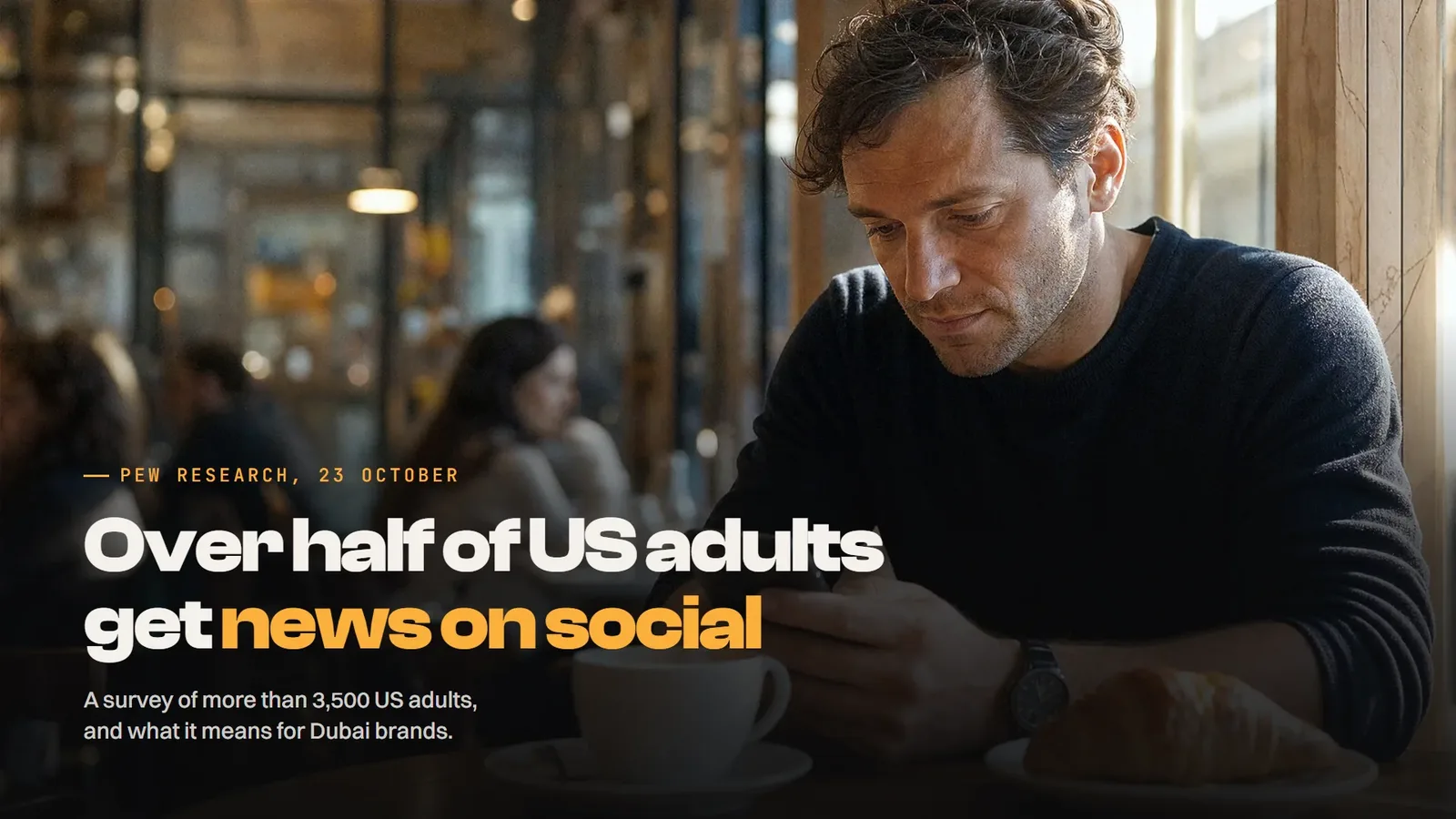
On 23 October, Pew Research published a new report on how Americans follow the news. It found that more than half now count social media as a main way to get news and information. Social Media Today covered the findings, and they matter to brands well beyond the US.
If your customers follow events through their feeds, they read your brand's updates in the same frame of mind. This guide covers what the survey found and how the numbers have moved over four years. It then turns to what a business in Dubai should change now, and where the American data stops being useful for the UAE.
What the Pew survey found
Pew based the report on a survey of more than 3,500 US adults, carried out in June this year. Its headline finding is that a clear majority of Americans consider social media an important way to stay connected to current events. That majority is where the "more than half" in every headline comes from.
A smaller group goes further. Roughly one in eight Americans say social media apps are their single most important source of news. For that group, the feed has replaced the news site and the evening bulletin as the main channel for staying informed.
These statistics from the study describe how people rate social media as a news source. The survey didn't log time spent in each app or count what people read, so it says more about trust than attention. Keep that in mind when you plan content, because the two are different things.
How the numbers moved in four years
Pew asked the same questions four years earlier, which gives the survey data a clean baseline. Back then, fewer than half of US adults said social media was an important way they got news. Only about one in 20 called it their most important news resource.
In four years, the broad group has increased from under half of adults to well over half. The group that relies on social apps above everything else has more than doubled in the same period. Those are big moves for a daily habit as settled as the way people follow the news.
The direction is clear even if you set the exact figures aside. A growing share of Americans use social media to follow events as they happen, instead of waiting for a broadcast or a morning paper. Social media usage for news is now a mainstream habit in the US, and the habit is still growing.
Why platform rules matter more now
Much of the Social Media Today article looks at a wider debate about who sets the rules. If social media platforms carry this much news, their moderation choices shape what millions of people see. Each platform's policy decides which claims spread and which ones fade from view.
Ranking systems on social media add another layer. Platform algorithms reward the updates that draw engagement, whatever the claim inside them happens to be. In practice, the article notes, that tends to give the most controversial discussions more exposure than calm ones.
Meta is the clearest recent example. In an earlier post, Mark Zuckerberg wrote that people engage disproportionately with sensational content when it is left unchecked. Early last year, Meta moved away from fact-checking and relaxed some rules on topics such as immigration and gender identity.
X, formerly Twitter, is the other case the article raises. Elon Musk bought it partly over concerns about how the old management handled which messages gained traction. Whatever you think of those decisions, the lesson for brands is the same. The rules behind a feed can change quickly, and with them what your audience sees.
What it means for businesses in Dubai and the UAE
Pew surveyed American adults only, so none of its findings describe the UAE directly. Don't quote them as local figures in a pitch, a report or a board deck. What they do give you is a clear signal about how people treat the apps your brand already uses every week.
Some businesses here feel the change directly. A Dubai company that sells to customers in the US is talking to an audience that leans on feeds for information. Brands with American residents among their followers are in a similar position.
For everyone else, the lesson is about trust. When people check social media every day to understand what's happening, your update sits in the same feed as the news. Readers judge it by the same standard, whether you meant it as news or not.
That raises the bar for accuracy in everything your brand says on social media. A loose claim about a policy change can travel further than you planned. Someone who checked the facts may then correct it in public, under your brand name.
B2B brands sit inside this too. A buyer comparing suppliers reads company updates and comment threads as evidence of how a firm works. What you publish on LinkedIn becomes part of the record they rely on when they draw up a shortlist.
Platform by platform: what to check first
The Social Media Today write-up doesn't break the Pew figures down by platform. It doesn't say how many adults use TikTok for news, for example, or how that compares with Facebook. Treat any platform split as something to check in your own data before you change a plan.
Each social media site still plays a different role for most audiences. The notes below are a starting point for planning news-style updates. Your own analytics should have the final word on where your customers spend their attention.
Facebook and Instagram
Many brands in Dubai run Facebook and Instagram from one Meta business account. When Meta changes a rule, plan as if it touches both platforms until you know otherwise. The move away from fact-checking is also a good reason to read your comment threads more often.
Facebook groups and pages often pass local updates well beyond your own followers. If you share news about opening hours, new locations or service changes, write it so it still makes sense when shared out of context. Put the date in the text as well as in the image, so an old screenshot can't mislead anyone.
If you use Instagram for product news, put the main fact on the first frame of a carousel. People who skim the image and move on will still get the point. Brands that use Instagram Stories for updates should pin the important ones to the profile, so new visitors can find them later.
Under each update on Instagram, keep a short, plain caption that repeats the fact and the date. That helps people who arrive later from search or from a share, long after the Story has gone.
Your Facebook users and Instagram followers can be quite different groups, even for the same brand. Check each audience on its own before you assume one message suits both.
TikTok and YouTube
If your audience skews younger, check how many of your followers actively use TikTok and YouTube before you plan a news-style series. Look at the age group split in your analytics, comparing how followers in the youngest age range use each platform with older ones. Then decide where each update belongs, and which ones need a video at all.
On TikTok, a person speaking to camera about a real change tends to feel more like information than an advert. Keep the facts tight and say where viewers can check them, ideally on a page you control. On YouTube, longer explainers give you room to show your working and answer the questions people ask most.
If you cut one clip for TikTok and Instagram, watch the comments on each. The same message can land differently with each audience, and the replies will tell you which version people trusted.
X and LinkedIn
X is built around live conversation, so it suits short updates during a launch or an event. Keep each message self-contained, since replies and quotes often travel without the original.
LinkedIn suits B2B updates, such as a change in how you work or a new service line. Write those updates for a buyer who wants the facts in the opening lines, not after a long introduction.
How to write a social update people can trust
Start a social media update with the fact. Put the change, the date and who it affects in the first line, before any brand language. Then add one line of context, such as why it changed or what the reader should do next.
Keep the tone plain and leave out hype words, because they make an update read like an advert. Close with a source, which can be a link to your own page, an official notice or the original report. This article does the same with its link to the coverage of Pew's findings.
Finally, check the update on a phone before it goes live. Many people will be reading it in a busy feed with the sound off, so the words on screen have to work alone.
Examples for common Dubai sectors
A clinic announcing a new treatment should state what it is and who it suits in plain words. Health updates get read closely, so link to the treatment page rather than making claims in the caption.
A retailer sharing sale dates should put the start and end dates in the text. Screenshots of an old sale poster can circulate on Instagram long after the sale ends, and customers then arrive expecting a price that has gone.
A property developer sharing a launch update should separate confirmed details from plans. Followers who read their feeds as news will treat a rendering or a target date as a promise.
A fintech firm changing its fees should explain the change before customers find it on their statement. A short update with a link to the full terms does more for trust than a long thread of replies.
Mistakes that cost trust
The first mistake is sharing a figure without naming where it came from. If you quote research, name it and link to it, the way this article names Pew and links to the coverage.
The second is borrowing a trend without checking it first. A viral claim about a new rule in Dubai may be wrong, and repeating it puts your name on the error.
The third is deleting a wrong update quietly. A short correction that says what changed reads better than a message that vanishes without a word.
The fourth is treating every social media platform the same. A caption written for Facebook rarely works as a TikTok script or an Instagram Reel. The audiences on each may differ in age and habit too.
What to track in your own usage data
Your own analytics are the closest thing you have to a local version of this survey. Start the analysis with usage by platform, by age and by time of day, and compare it with a year ago. If usage of Instagram has grown while Facebook has stayed flat, your news-style updates should follow that shift.
Watch the share of visitors who reach your site from social media platforms, as well as the follower count. A rising share suggests more people treat your feed as a route to information about your brand. A falling one is an early sign your content needs to be more useful.
Keep a record of which topics drew questions in the comments, particularly on Instagram. Watch how saves and shares on Instagram move after a news-style update, since both suggest people found it worth keeping. Those data points reveal what your audience wants explained next, and they make good material for the next update.
What a Dubai business should do now
Check every factual claim before you publish. A wrong date or figure spreads further now that more people treat feeds as news, and corrections rarely travel as far as the mistake.
Give each social media update a source. Link to the page on your site where the full detail sits, so readers can confirm it without messaging you first.
Share updates while they're useful. A change to opening hours that goes out days late reads as careless, even when the content itself is right.
Match the format to the platform, and to what is popular with your own followers. A carousel on Instagram, a short video on TikTok and a plain text update on LinkedIn can each hold the same fact.
Watch the comments on anything that touches a live topic. With lighter moderation on some apps, you'll often be the one who has to correct a wrong reply.
Track what happens after people read. Reach as a metric on its own says little about whether an update was trusted or acted on.
Measure trust as well as reach
When feeds work as news, an update's job is to inform people and then move them to act. Likes and other interactions on social media are signs of attention. Site visits, saved updates and enquiries are signs that people believed what they read.
That's why we connect social data with what happens on the website and in the sales pipeline. The Adnika Dashboard: one live view of a client's ads, analytics and CRM data, with AI recommendations reviewed by the strategist. For a social media client, it brings together which updates sent people to the site and which of those visits turned into enquiries.
If you run an active social media account, linking updates to results is how you learn which ones people trust. For help planning updates that stay accurate and still perform, see how our social media agency in Dubai works with brands across the UAE.
Read the US numbers with care
A few caveats keep this survey in proportion. The findings describe adults in one country, surveyed once in June. They capture how important people say social media is for news, which differs from how far they trust any given update.
The report looks at how Americans get news on social media. It says nothing about how they shop or which ads they trust, so treat these statistics as a US benchmark and nothing more.
The four-year comparison is strong because Pew asked the same questions both times. Stats on social media usage from other sources may use different wording, so don't mix them with these numbers. If you need UAE figures for a plan, find a local source and cite it.
The article's wider point remains either way. Social platforms now handle a larger share of the news people see than four years ago, and the rules that shape those feeds keep shifting. Brands that publish accurate, sourced updates are on the right side of both trends.
The short version
More than half of American adults now see social media as an important news source, a sharp rise over four years. That puts brand updates in the same feed as the news and raises the cost of getting a fact wrong. For a Dubai business the response is practical: check claims, cite sources and track what people do after they read.
Most brands do not need more content for this. They need content that holds up when a reader treats it as news.