Contents6
Anthropic told API customers by email that its text watermark is spreading to four more Claude models, The Decoder reports. The mark will cover Claude Mythos 5, Claude Opus 4.7, Claude Opus 4.6 and Claude Sonnet 4.6. Newer models such as Claude Opus 5.5 already carry it. The report gives no start date, and the rollout on Amazon Bedrock may take a few extra days.
What changes for API users
Anthropic describes the mark as an "imperceptible pattern in word choice" that leaves meaning, quality and readability alone. The company says it adds no extra characters or tokens and doesn't touch pricing or the format of requests and responses. Anthropic says output slows only a little and the mark holds no information about the user, their organisation or their conversations with Claude.
Where the loophole sits
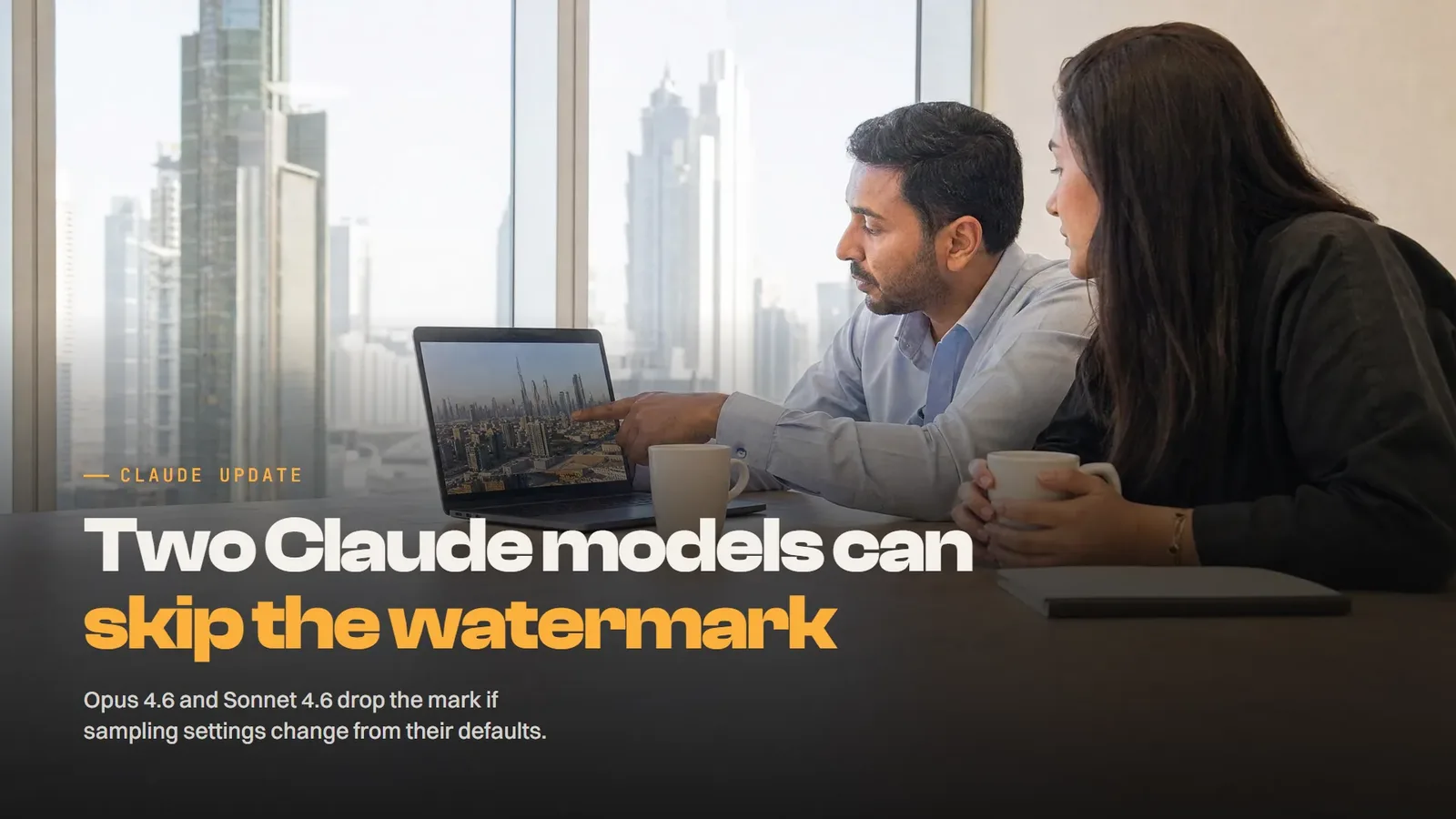
The gap is on Claude Opus 4.6 and Sonnet 4.6, where the watermark only runs when temperature, top_p and top_k stay at their defaults. These settings control how much randomness the model uses when it picks words. A small change to any one of them is enough to avoid the mark.
Anthropic's email tells customers who depend on the mark for compliance to leave those settings at their defaults. It doesn't give the same caveat for Claude Mythos 5 or Claude Opus 4.7, which suggests the mark applies there whatever the settings. The gap still matters, because The Decoder rates Opus 4.6 above Opus 5.5 for writing.
Why the rollout is happening now
Anthropic points to the EU AI Act's December deadline as its reason for watermarking older models. Every model released after 2 August this year carried the mark from day one, and older models are getting it in stages. The mark sits at the model level, so it follows the model onto every platform that hosts it. That includes Amazon Web Services, Google Cloud and Microsoft Foundry, and customers can't turn it off.
Who this affects in the UAE
The report doesn't mention the UAE or list any regional exception, so plan as if your Claude text carries the mark in Dubai too. That covers every business calling these models through an API, whether directly or through a cloud platform. UAE firms with EU clients have the most reason to pay attention, since the deadline behind this rollout is European.
Anyone whose clients ban AI use has a separate problem. The legal trade outlet Artificial Lawyer raises this for law firms, where a client could find the mark in a document. Several watermarks layered in one document could also cause complications, the outlet says. Agencies and contractors working under the same kind of clause face a similar risk.
What a Dubai business should do now
List every Claude model you use and the platform it runs on, so you know which ones sit inside the gap.
Check the sampling settings on any Opus 4.6 or Sonnet 4.6 integration. Leave all three at their defaults if you count on the mark for compliance.
Tell your developers, because a routine tweak to one setting is all it takes to lose the mark on those models. A team new to these settings may want AI corporate training in Dubai before it edits live integrations.
Don't treat the mark as proof on its own yet, since Anthropic's detection API for verifying it is still in private preview.
Read your client contracts for any ban on AI, and raise the watermark with those clients before they find it themselves.
Keep a human editor on copy where the exact word matters, including any AI content generation work you run. Anthropic says quality doesn't change, but blogger John Gruber argues that picking words by a watermark instead of by meaning must cost some precision.
Why human review still matters
A hidden mark may show that a model wrote a passage, but it won't show that anyone checked it. That's the reason our client reporting keeps a person in the loop. The Adnika Dashboard: one live view of a client's ads, analytics and CRM data, with AI recommendations reviewed by the strategist. So when a client there asks who checked the AI's work, the answer is the strategist, and no watermark can tell you that.
If you want help mapping your models, settings and client terms, start with our team at this AI agency in Dubai.