Contents30
- The short answer: ChatGPT drafts, a copywriter decides
- What ChatGPT does well in copywriting
- Where ChatGPT falls short as a copywriter
- It writes the average of what it has read
- It has no access to your evidence
- It invents details with confidence
- It can't tell which worry decides the sale
- How to spot copy ChatGPT wrote on its own
- Why copy that sells starts before the first sentence
- The facts problem: confident text with nothing behind it
- Brand voice is harder to copy than it looks
- Writing for Dubai in Arabic and English
- Search, AI answers and the copy that gets cited
- Ads copy: where speed helps and where it hurts
- The real cost of AI copy
- How to split the work between ChatGPT and a copywriter
- A working process for AI-assisted copy
- Start with a written brief
- Give the model only verified material
- Ask for angles before finished copy
- Edit like a sceptic
- Read it aloud before it goes live
- How to prompt ChatGPT for better copy
- What to check before AI copy goes live
- Common mistakes teams make with AI copy
- When it makes sense to rely mostly on AI
- When you still need a copywriter
- How the copywriter's role is changing
- How Adnika uses AI in client work
- Where to start with your own copy
Most marketing managers have asked this by now, often after ChatGPT wrote a product description faster than anyone on the team could type one. The draft looked tidy, it read smoothly and it cost almost nothing to produce. So the next thought is an obvious one for anyone watching a budget: why keep paying a copywriter?
The answer depends on what you need the words to do. For a first draft or a cleaner version of a clumsy paragraph, ChatGPT is quick and genuinely useful. For copy that has to persuade a specific buyer to act, the model is missing most of what the job requires.
This guide covers where ChatGPT helps, where it fails and how to split the work between the tool and a writer. The aim is to keep the speed of AI without ending up with the bland, interchangeable copy buyers scroll straight past.
The short answer: ChatGPT drafts, a copywriter decides
ChatGPT is a language model, which means it writes by predicting the most likely next words based on the text it was trained on. The result is fluent writing on almost any subject, in almost any tone, delivered in seconds.
What the model doesn't have is knowledge of your business beyond what you type into the prompt. It hasn't spoken to your customers or sat in on your sales calls. It can't tell whether a claim it writes is true for your product either, because it has no way to check.
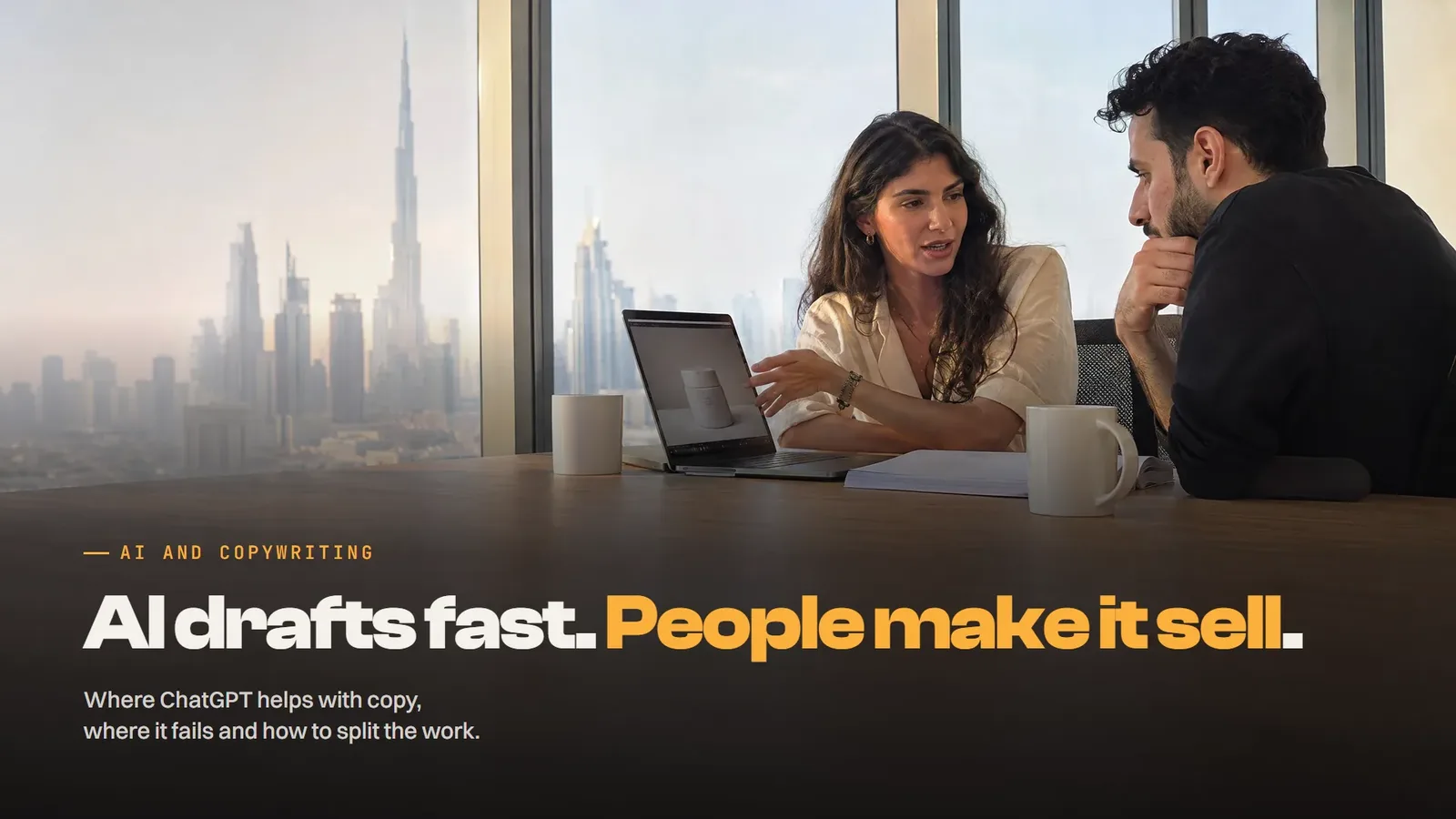
Those gaps are where a copywriter earns their fee. A good one finds out what the buyer wants, picks the message to lead with and makes sure every line can be backed up. Put simply, ChatGPT can write, but it can't decide what's worth writing. For anything that has to sell, someone still needs to make those decisions, and that someone is usually a copywriter.
What ChatGPT does well in copywriting
Give ChatGPT a clear brief and it saves time on the parts of copywriting that are mostly mechanical. These are the jobs it tends to handle well when a person sets it up properly:
Rewriting a clumsy paragraph so it reads more smoothly while keeping the meaning you started with.
Producing a long list of headline or subject line options, so you have more to choose from and test.
Cutting an approved page down into shorter versions for an email preview or a social caption.
Changing the reading level of a draft, for example making a technical page easier for a general reader.
Summarising long source material, such as a product manual or a call transcript, into notes a writer can use.
Suggesting a structure for a long page, including the sections a reader would expect and the order they come in.
In each of these jobs the model works on material you already trust. You bring the facts and the judgement, and ChatGPT handles the typing and the variations. That's where the time savings are genuine, and it's where most teams should start.
It's also useful as a critic when you're stuck on a page. Ask it to argue against your headline and it will often raise a point you had missed. You can also ask for the objections a sceptical buyer might raise, then check whether your page answers each one.
Where ChatGPT falls short as a copywriter
The weaknesses show up as soon as the copy has to persuade a real person to spend money. Most of them come from how the tool works, so better prompts reduce them without removing them.
It writes the average of what it has read
Ask for a landing page for a dental clinic and you'll get the page most dental clinics already have. The promises are the ones your competitors make, arranged in a slightly different order. Nothing in it is wrong, exactly, but nothing in it would make a buyer choose you over the clinic next door.
It has no access to your evidence
Copy sells when it gives the buyer a reason to believe, and that reason has to come from your business. It might be a result, a method or a detail only your team could mention. ChatGPT can't supply any of those, so it fills the space with general claims anyone could make.
It invents details with confidence
When the prompt leaves a gap, the model often fills it with a plausible figure or feature that doesn't exist. The sentence reads naturally, which is exactly why it slips past a quick review. Published copy with an invented claim does more harm than no copy, especially where buyers make health or money decisions.
It can't tell which worry decides the sale
A copywriter learns from customer interviews and sales calls which concern stops people from buying. The model only knows what worries people in general, which is rarely the one that decides your sale. Copy aimed at the wrong worry can be well written and still fail to convert.
How to spot copy ChatGPT wrote on its own
Unedited AI copy has a recognisable feel, and your buyers have read enough of it to notice. The openings are general, often a sentence about how fast the world is changing or how important the topic has become. Paragraphs follow the same shape, with a claim, a short explanation and a neat closing line.
The vocabulary gives it away as well, because the same grand verbs turn up on page after page. Lists tend to come in threes, and every section ends on a tidy summary. What's missing is anything specific, like a detail from a real customer or a result from your own records.
None of this matters much for an internal memo, but it matters a lot on a page that's meant to win business. Buyers who spot generic copy tend to assume the business behind it is generic too, and they move on.
Why copy that sells starts before the first sentence
Most of a copywriter's work happens before any writing begins. They read the reviews customers leave, listen to how the sales team handles objections and look at which past campaigns brought in buyers. From that research comes one decision about who the copy is for and what it needs to make them believe.
ChatGPT skips this step unless you do it for the model. If your prompt only says "write a homepage for a fitness studio", the model has to guess everything else. Its guesses will be the most common ones, so your page ends up sounding like every other studio's page.
The brief is where the difference gets made. A strong one names a single reader, the problem they want solved and the proof you can offer them. Write that brief well and even ChatGPT can produce something usable, because most of the thinking is already done. Skip it, and no amount of prompt tweaking will rescue the draft.
The facts problem: confident text with nothing behind it
Language models are built to produce text that sounds right, which isn't the same as text that is right. That's the most important thing to understand before you publish anything ChatGPT writes about your business.
In practice the errors are small and easy to miss. A draft might mention a feature you don't offer, a delivery time you can't meet or a statistic with no source. Each one reads naturally, so a quick skim won't catch it.
For general content, an error like this is embarrassing. For a clinic, a bank or a property developer, it can mislead people making decisions about their health or their money. Copy in those sectors needs a person who checks every claim against something the business can prove.
The fix is easy to describe and slow to do. Give the model your verified facts, tell it to add nothing else and then check the output line by line anyway. Treat every number and promise in an AI draft as unconfirmed until someone has checked it against your records.
Brand voice is harder to copy than it looks
You can paste your brand guidelines into ChatGPT and ask it to write in your voice. The result usually catches the surface, such as sentence length and formality, and misses the substance underneath.
A brand voice is more than a tone setting. It's the things you refuse to say, the claims you'd never make and the subjects you keep coming back to. Those choices come from the people who run the business, and they change as the business learns what works.
Over a long campaign, AI copy tends to drift back towards the generic. Phrases creep in that your team would never use, and the content starts to sound like a template. Readers pick up on this quickly, and once they decide the words are filler they stop reading.
A copywriter keeps the voice consistent across a website, an email series and a year of social posts. They also notice when the voice needs to change, which a model working from last year's guidelines can't do.
Writing for Dubai in Arabic and English
Marketing in the UAE adds problems a general-purpose model handles poorly. Your buyers might read in Arabic or English, and many switch between the two depending on the channel.
ChatGPT's Arabic can be grammatically correct and still miss how people in the Gulf write and speak. A direct translation of English copy often reads as stiff, and the same happens when Arabic copy is translated into English. Good bilingual copy is written for each audience, with its own references and its own way of making a point.
At Adnika we work in Arabic and English, and the same rule applies to both languages. A model can give you a starting point, but a native writer decides whether it sounds like something people in Dubai would say.
Cultural detail matters as much as language, from family values to what counts as a polite way to sell. Seasonal campaigns around Ramadan or a national day need a writer who knows the audience well. A model working from global examples tends to miss those details or handle them in a way that feels borrowed.
Search, AI answers and the copy that gets cited
Search has changed the copywriting brief as well. Pages now compete for a place in Google's results and for a mention inside the answers AI assistants give.
Generic AI-written pages struggle on both fronts, for the same reason. Search engines reward content that shows first-hand experience and clear expertise, and a page built from the average of the web has neither. AI assistants such as ChatGPT and Perplexity behave in a similar way, because they tend to favour sources that give specific information. The way those tools choose what to quote is covered in detail in our guide to getting your brand cited by ChatGPT and Perplexity.
This is where a copywriter adds the most value for search. They pull out the details only your business knows, such as how a service works in practice. Then they put those details on the page in words that both readers and search engines can use. A model can tidy that material into clean paragraphs, but it can't produce the material in the first place.
Ads copy: where speed helps and where it hurts
Paid ads are where ChatGPT looks most useful at first glance. Ad platforms reward testing several versions, and the model can write a full set of headline options almost instantly.
The catch is that volume isn't the same as variety. Many of those headlines repeat one idea in different words, so the test compares near-identical ads and teaches you little. A useful test compares different angles, such as price against convenience or speed against reassurance. Choosing those angles is a strategy decision, and it comes from knowing the buyer.
Ad copy also has to match the page it sends people to. When an AI-written ad promises one thing and the landing page says another, you pay for clicks that never turn into leads.
Personalised campaigns need even more care, because each audience segment needs a message of its own. For German Medical Center, a clinic in Dubai, Adnika built deeply segmented audiences and ran personalised Google and social media ads against them. Work like that multiplies the amount of copy a campaign needs, and a model can help produce the variations quickly. Someone still has to decide what each segment should hear and check every version against what the clinic offers.
The same thinking applies to ads that run inside ChatGPT itself. Adnika already runs ChatGPT Ads campaigns for businesses in Dubai through our ChatGPT Ads agency in Dubai.
The real cost of AI copy
ChatGPT looks almost free next to a writer's fee, but the comparison leaves out the time AI copy takes to fix. Someone has to write the brief, check every claim and rewrite the generic parts before the page is fit to publish. If that someone is a senior person on your team, the hours add up quickly.
There's also the cost of copy that underperforms. A landing page that converts poorly costs you on every paid click it receives, for as long as it stays live.
A fairer comparison sets the full cost of each option against what the copy has to achieve. For low-stakes content, AI with light editing usually wins on cost. For the pages that bring in leads, the writer's fee is often the cheaper option once you count what weak copy loses you.
How to split the work between ChatGPT and a copywriter
For most teams the useful question is which parts of the job each one should own. Here's a split that works for most marketing content, from service pages to email campaigns:
The copywriter owns the research and the brief, including the decision about which message leads.
ChatGPT produces a first draft from that brief, along with alternative headlines for the copywriter to choose from.
The copywriter edits the draft until every line is accurate and sounds like your brand.
ChatGPT adapts the approved copy for other formats, such as email previews and social captions.
The copywriter reads every version one last time before anything is published.
In this setup the model speeds up the slowest typing work, while a person stays responsible for what the copy says. Done well, you get more copy from the same hours without lowering the standard. The risk comes when deadlines push the editing step aside and drafts go out as they are.
A working process for AI-assisted copy
If you want to use ChatGPT for copy, a simple process keeps the quality up. These steps work for a single landing page as well as for a full content plan.
Start with a written brief
Write down who the reader is and what stops them from buying today. Then list the facts you can prove, including anything your competitors can't say about themselves. A brief like this takes time, and it's the step most teams skip when they rush to the prompt.
Give the model only verified material
Paste your brief and your facts into the prompt, and tell the model to use nothing else. Ask it to flag any sentence where it needed information you didn't provide, so you can see where it was tempted to guess.
Ask for angles before finished copy
Request several angles for the headline and the opening paragraph before you ask for a full page. Choosing between angles is a human decision, and it's quicker when you have real alternatives side by side.
Edit like a sceptic
Read the draft the way a doubtful buyer would. Cut every sentence that could appear on a competitor's site unchanged, and replace it with a detail only you can offer. Check every claim against your facts, and delete the ones you can't back up.
Read it aloud before it goes live
Reading aloud catches the stiff rhythm and repeated phrases AI drafts are prone to. If a sentence sounds like something nobody would say to a customer, rewrite it in plain words.
How to prompt ChatGPT for better copy
Better prompts won't fix the problems above, but they do narrow the gap. The most useful change is to give the model a reader and a set of facts instead of asking for finished copy.
A weak prompt asks for "a landing page about our cleaning service". A stronger one describes the reader, such as a busy parent in Dubai who has been let down by a previous cleaner. It lists the facts you can prove, names the action you want the reader to take and sets the length. It also tells the model to leave out invented figures and claims about being first.
Give the model examples of copy you like from your own site, so it has something closer to your voice than its default. Ask for short sections one at a time rather than a whole page in one go, because long outputs drift. When a draft misses, tell the model exactly what was wrong instead of asking it to try again.
Even with a strong prompt, treat the output as a draft. Prompts improve the starting point, and the editing still decides whether the copy is ready.
What to check before AI copy goes live
A short checklist stops AI drafts from causing problems after they're published. Run every piece through it, whoever or whatever wrote the first version:
Every figure and client name appears in your own records, with a source you could show a customer.
No sentence promises something your team can't deliver, such as a timeline or an outcome.
The first lines say something specific about your business instead of a general opening.
The copy matches the voice of your other pages, including the words your brand never uses.
Any statement about health or money has been checked against a source you trust.
The call to action matches what the page offers and where the button leads.
If a draft fails any of these checks, it goes back for editing, however good it sounds. Fluent writing is the easy part now, and fluent writing that turns out to be wrong costs more than slow writing that's right.
Common mistakes teams make with AI copy
The same handful of mistakes turns up again and again when teams start using ChatGPT for marketing. Most of them come from treating the tool as a writer instead of as a drafting assistant.
Publishing the first draft as it stands, because it reads smoothly and the deadline is close.
Prompting with a one-line request and no facts, then blaming the model for generic output.
Letting ChatGPT write about a subject nobody on the team knows well enough to check.
Translating English copy into Arabic word for word instead of writing for each audience.
Producing more pages than anyone can review, so small errors pile up across the site.
Judging AI copy by how polished it sounds rather than by whether it would persuade your buyer.
Each of these is easy to avoid once someone owns the final version. The tool is rarely the problem, and the missing step is almost always the human review.
When it makes sense to rely mostly on AI
There are jobs where ChatGPT can do most of the work with light editing. Internal documents, first-pass meta descriptions and product listings built from a clear spec sheet are good examples. In these cases the facts come from a structured source, and the reader wants clarity more than persuasion.
The same goes for repetitive formats you've already written well once. With an approved template for event announcements, the model can fill in new details quickly. A person should still check names, dates and claims before anything goes out.
Small businesses with no marketing budget often start here, and that's a reasonable choice. A clear AI-assisted page is better than no page, provided someone who knows the business reads it before it goes live.
When you still need a copywriter
Some copy carries too much weight to hand to a model. Your homepage, your main service pages and your highest-spend campaigns decide whether a visitor becomes a lead. Small improvements in how those pages convert can be worth far more than the cost of writing them well.
You also need a person when the subject is sensitive. Buyers of healthcare, finance and property make careful decisions, and they notice copy that overpromises or stays vague. In those sectors, a writer who understands the category protects the brand while selling for it.
And you need one when the brand is the product. If people buy from you because of how you talk and what you stand for, the words can't come from a model's average.
Pages built on specific facts are another case where a writer earns their place. For Roxana Aesthetics, an aesthetic and dermatology clinic in Dubai, Adnika rebuilt the website around its treatments rather than the brand. Each treatment got its own page, and each of those pages needed copy about that treatment and the people asking about it. A generic AI draft falls short on pages like these, because the useful detail lives with the clinic rather than on the open web.
How the copywriter's role is changing
The copywriter's job is shifting rather than disappearing, and the change shows in what good writers spend their time on. Writers who use AI well spend less time typing first drafts and more time on research and editing. The value moves towards the parts a model can't reach, such as knowing the customer and choosing the angle.
For hiring, this means looking for writers who can research and edit as well as write. A writer who only produces clean sentences is competing with a tool that does the same thing for almost nothing. A writer who can find the insight behind a campaign is worth more now, because every competitor has the same fluent drafts.
For business owners, the takeaway is to spend money on thinking rather than typing. Use the model for volume and pay for judgement where the copy carries real weight.
How Adnika uses AI in client work
Our own use of AI follows the same split, with the model suggesting and a person deciding. You can see it in the reporting tool we give clients.
The Adnika Dashboard: one live view of a client's ads, analytics and CRM data, with AI recommendations reviewed by the strategist. For a client, a suggestion about which ad message to change arrives already checked by the person who knows the account.
Our team brings 15+ years of experience to the parts of the job a model can't do, from research to the final edit. If you'd rather hand the research, the brief and the writing to one team, start with our work as a content marketing agency in Dubai. Businesses that want AI built into their own marketing workflows, with people still checking the output, can start with our AI agency in Dubai. Copy is usually one part of a wider plan, and that plan is the job of our digital marketing agency in Dubai.
Where to start with your own copy
If you're deciding whether to replace your copywriter with ChatGPT, start by listing the copy your business produces in a typical month. Sort it by how much each piece affects sales, then decide where AI can take the first pass and where a person should lead. For most businesses the answer is a mix, with AI handling the volume and a writer owning the pages that sell.
Whichever split you choose, keep one rule: nothing goes live until someone who knows the business has read every word. ChatGPT can make that person faster, but it can't take their place on the copy that brings in your customers.