Contents20
- EEAT in SEO, Explained in Plain Words
- How Google Evaluates EEAT, and What It Isn't
- The Four Parts of EEAT
- Experience: Doing the Thing You Write About
- Expertise: Knowledge and Skill in the Field
- Authoritativeness: A Reputation Others Confirm
- Trustworthiness: The Part the Others Support
- Why EEAT Matters Most for YMYL Topics
- EEAT on Bilingual Websites in the UAE
- How to Show EEAT on Your Website
- Put Real Names on Your Content
- Build a Proper About Page and Contact Details
- Cite Sources and Keep Pages Current
- Show Firsthand Proof
- Earn Links and Mentions Instead of Buying Them
- Make the Website Safe and Easy to Use
- Common EEAT Mistakes to Avoid
- What EEAT Looks Like in Real Client Work
- EEAT, Ranking Drops and AI Search
- Where EEAT Fits in Your SEO Strategy
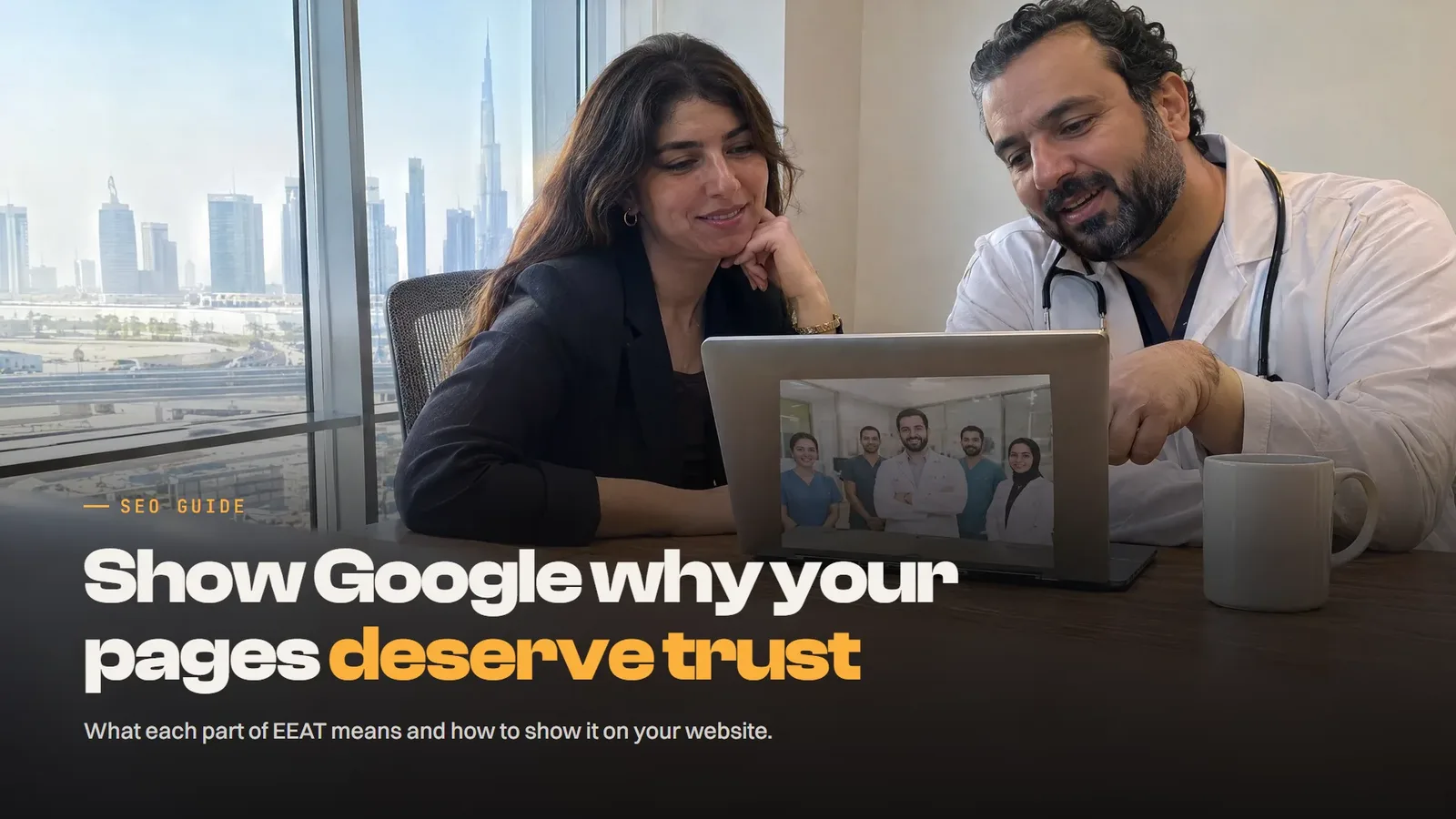
Most business owners first hear about EEAT after a drop in traffic, when pages that ranked well slide down after a Google update. The term sounds technical, but the principle behind it is simple. Google wants to send searchers to content written by people who know the subject, on websites it has good reason to trust. This article explains each part of EEAT and how to demonstrate it on your own pages.
EEAT in SEO, Explained in Plain Words
EEAT stands for experience, expertise, authoritativeness and trustworthiness. The letters come from Google's Search Quality Rater Guidelines, the handbook it gives to the people who review search results by hand. For years the framework was known as the original E-A-T, with three parts and no mention of experience. Google later added the extra E, since firsthand use of a product often matters as much as formal training.
The four parts carry different weight. The guidelines describe trust as the most important component, and the other three help a page earn it. Content written by a real expert still fails on trust if its claims are wrong or its owner is hidden. Put simply, when Google evaluates a page against EEAT, it asks one question: should a reader rely on this?
How Google Evaluates EEAT, and What It Isn't
EEAT isn't a single ranking factor, and no tool can give your website an official EEAT score. Google's quality raters judge sample results against the guidelines, but their judgements don't move any page up or down directly. Instead, Google uses their feedback to check whether its ranking systems keep surfacing helpful, reliable results. The evaluators are a small part of Google's testing process, not a team assessing your site in particular.
What the systems look for are signals that tend to line up with EEAT. Those signals include mentions on respected sites, accurate information and a long history of satisfied visitors. Google values high-quality content made to help people first, and it asks content creators to review their own pages with the same eye. Its published self-assessment questions are a good place to start that review.
The Four Parts of EEAT
Each part focuses on a different question a reader might ask about your content. Here is what each one means and what raters expect to see.
Experience: Doing the Thing You Write About
Experience asks whether the content creators behind a page have used the product or done the task themselves. A review of a treatment written by someone who had it reads differently from a summary of other people's reviews. Raters look for real-life experience in the details, such as original photos and drawbacks only a real user would know. You prove it by writing from your own work and stating clearly what you tested before you wrote about it.
Expertise: Knowledge and Skill in the Field
Expertise is the knowledge and skill a content creator brings to the subject. For a recipe, everyday skill is enough, but content about heart medication needs someone with formal training in the field. The guidelines say the level of expertise a page needs depends on the topic and the potential harm of getting it wrong. Author bios, relevant credentials and samples of past work let a reader check who wrote the content and why.
Authoritativeness: A Reputation Others Confirm
Authoritativeness is about reputation, both for the content creators and for the website as a whole. A site gains authority when other respected sites cite it, link to it or name it as the place to go for a topic. You can't grant yourself authoritativeness on your own pages, because it lives in what others say about you. You establish it through coverage in the press, membership of professional associations and steady mentions on respected websites in your industry.
Trustworthiness: The Part the Others Support
Trustworthiness sits at the centre of the framework, and Google treats an untrustworthy page as low quality whatever else it offers. Trust starts with accuracy, which means facts that are correct, current and backed by sources a reader can check. It also covers whether a reader can see who runs the website and reach them without effort. On a shop or booking page, website security and a clear refund policy form part of that trust as well.
Commercial honesty matters too, so if you earn a commission from a recommendation, disclose it clearly. Hidden conflicts of interest damage trustworthiness quickly, and a single false claim can undo years of credibility. Check every figure against its source before you publish new content.
Why EEAT Matters Most for YMYL Topics
Google holds some topics to a higher standard than others. It calls them Your Money or Your Life topics, or YMYL, since bad advice on them can do real harm to a reader. Medical and financial pages sit at the top of that list, along with legal guidance and news about public safety. For these pages, raters hold trustworthiness to a higher bar and expect clear authorship by a qualified person.
This is why a clinic website in Dubai needs more than well-written treatment pages. Each piece of medical content should name the specialist behind it, show when it was last reviewed and stay up-to-date as guidance changes. Clinics have more to prove than most businesses, and that standard shapes how we approach healthcare SEO in Dubai.
EEAT on Bilingual Websites in the UAE
Many UAE businesses publish content in both Arabic and English, and EEAT applies to each version on its own merits. A translated page with no author, no citations and a stiff machine-translated tone loses the standing the English page has built. Name the author or reviewer on both versions, and choose references that suit an Arabic-speaking reader where you can. Keep the facts identical across languages, since a figure that differs between versions makes readers question both.

How to Show EEAT on Your Website
You can send stronger EEAT signals without building a new website. Most of the work is careful housekeeping on the content you already have, done in a sensible order and kept consistent across the site. The following steps start with the quickest fixes and move on to the slower work of building a reputation.
Put Real Names on Your Content
Give every article a named author and link the byline to a short bio page. The bio should highlight the person's role, their training and the work that makes them worth hearing on the topic. Anonymous content creators give raters nothing to check, so a faceless blog loses credibility before anyone reads it. When a subject matter expert reviews content written by someone else, name the reviewer as well as the writer.
Build a Proper About Page and Contact Details
Your About page should explain who owns the business, where it operates and how long the team has worked in its trade. Display a real address and a working phone number, and if you sell online, explain how customer support works. These details look basic, yet a missing contact page is a common gap on small business websites.
Cite Sources and Keep Pages Current
Back every figure, rule or medical claim with a link to the original source. Readers and raters both use citations to check accuracy, and a page that cites nothing asks them to take its word for everything. Add a visible last-updated date and review older content on a schedule, especially pages about prices, laws or health. Stale content loses trust quietly, because one outdated fact makes readers doubt the rest of the page.
Show Firsthand Proof
Demonstrating experience is easiest with material nobody else has. Use your own photos and describe the steps you took, including what went wrong as well as what worked. A short case study with genuine detail does more for credibility than general content copied from elsewhere.
If you hold your own data, such as survey results or measurements from your projects, publish it with a note on how you gathered it. Consumers are quick to spot stock images and recycled tips, and both weaken the experience signal.
Earn Links and Mentions Instead of Buying Them
Authoritativeness comes from other people, so the aim is to be cited by high-quality sites your buyers already respect. At Adnika, link building is done selectively and never bought in bulk, through content worth citing, digital PR and genuine partnerships. Bought links tend to come from weak sites, and they can put the whole domain at risk under Google's spam policies. A steady social media presence helps as well, because it points to a real business with real people behind it.
Make the Website Safe and Easy to Use
Trustworthiness also depends on how the site behaves once someone lands on it. Use HTTPS on every page and keep plugins patched, because a browser security warning can end a visit before anyone reads a word. A user-friendly layout matters too, with clear menus, readable text and no ads pushing the content off the screen. A good user experience doesn't replace expertise, but a cluttered page makes even strong advice look careless.
Common EEAT Mistakes to Avoid
A few habits undo good work faster than anything else. The first is publishing large batches of thin AI-written content with no named author and no original information. AI tools can help with drafts, but Google judges the result, and a page with nothing new to say isn't valuable to anyone. The second is vague authorship, such as invented experts or stock photos used as author headshots.
Another mistake is treating EEAT as a single page you add once, instead of a standard every page meets. Reviews also need care, because copying testimonials without consent or showing only glowing praise looks staged. Finally, don't hide the business behind a contact form alone, since a page with no way to reach a person invites doubt.
What EEAT Looks Like in Real Client Work
The steps above are easier to apply with examples, so here is how the same thinking appears in our own projects. Adnika rebuilt the Roxana Aesthetics website around its treatments rather than the brand. Each treatment at the aesthetic and dermatology clinic in Dubai has its own page, so each page can focus on one subject in depth.
German Medical Center, a multi-specialty clinic in Dubai, used to run two separate websites, one for organic and one for paid traffic. Adnika replaced them with one centralised WordPress site in English and Arabic. One site gives the clinic's authority a single home instead of splitting it across two.
An agency's credibility also depends on how openly it reports on its own work. The Adnika Dashboard: one live view of a client's ads, analytics and CRM data, with AI recommendations reviewed by the strategist. For an SEO client, it shows whether pages rebuilt around EEAT are bringing in organic visits and enquiries.
EEAT, Ranking Drops and AI Search
Sites hit by a core update often look for one technical fix, but Google's own guidance after these updates points back to content quality. One of its self-assessment questions asks whether you'd feel comfortable trusting a page with issues about your money or your life. If the honest answer is no, the problem sits with EEAT rather than with your code.
The same signals carry over into AI answers. AI assistants and Google's AI Overviews tend to quote content they can verify, and clear authorship makes your page easier to verify. For a fuller picture of how answer engines choose their sources, read our guide to AI search SEO in the UAE. Businesses that want to be named in those answers should treat EEAT as the base of answer engine optimisation.
Where EEAT Fits in Your SEO Strategy
Think of EEAT as the standard every piece of content has to meet, with technical work and keyword research built around it. Crawling and site speed still decide whether Google can read your pages at all, which is why technical SEO remains key. Reputation also builds slowly, so before you plan the work, read our breakdown of how long SEO takes to work in the UAE.
A quick test helps before you start. Read each page as a stranger would and ask whether you'd act on it without checking anywhere else. If the answer is no, note what's missing, whether that's a name, a source, a date or a way to get in touch.
Start with the content that matters most to your revenue and your visitors' wellbeing, then check each one against the four parts of EEAT. Fix trust gaps first, then add the experience and expertise your pages lack, and let authoritativeness follow from the work. If you'd like help with that review and the fixes that follow, speak to our SEO agency in Dubai.